




INDIA TOGETHER
 Wed 25 Nov 2009    The news in proportion.
NEWSLETTER
DIGITAL EDITION
PLEASE CONTRIBUTE
HOME OPINIONS SEARCH SUPPORT
NEWSLETTER
ENVIRONMENT
Environment issues page
Biodiversity
Climate
Education
Energy
Fisheries
Forests
Hazards
Mining
Opinions
Profiles
Regulation
Reviews
Urban
Waste
Water
Wildlife

RSS Feeds 
 
SERVICES
Advertise
Contact Us
Newsletter
Submit

DOMESTIC DECISIONS
The gift from the sky
Frustrated with the hardness of borewell water, H Ramesh and his family are harvesting rain in their Mysore house for almost all their domestic uses. Shree Padre has more.

 •  Write the author
 •  Environment
 •  Karnataka
 •  Send to a friend
 •  Printer friendly version
8 October 2008 - Mysore city may not have many parallels to H Ramesh and his family’s achievement. Since the last five years, this five-member family has been drinking only rainwater. Each of them is so passionate about ‘the gift from the sky’ that they are like fish out of water if compelled to use corporation water that is very hard in the areas around Bogadi in this city.

Way back in 2003, while planning their own house, H Ramesh, a Kaveri Irrigation Corporation employee, and his wife Vani had decided to harvest rain in a big way. There were reasons behind this decision. “This corporation water, drawn from local borewells is pretty hard. It doesn’t satisfy your thirst at all,” points out Vani. “Rice cooked with that water turns yellow and spoils by night. In contrast, rice prepared with rainwater looks as white as jasmine and remains in good condition even after a day or two.”

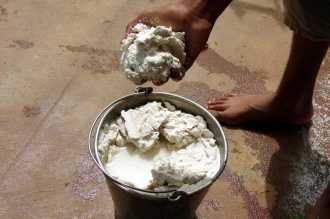
Scales accumulated in corporation water tank. Pic: Shree Padre.

Both husband and wife have spent considerable time and effort in planning out their decentralised rain storage system that supplies water to the consumption points by gravity. A 1,000-litres tank with readymade cement rings is located just outside the kitchen. Another 5,000-litres tank is by the side of the bathroom. Overflow from this tank fills an underground sump with a 6,000-litres capacity, situated below the portico. Any overflow from this sump plus the run-off from the rest of the house site with a floor area of 60 x 40 feet is not allowed to escape. A concealed 4 X 3 X 3 cubic feet rain pit just outside the gate percolates this water too. With this arrangement, this house has zero run-off.

Tapping 60,000 litres with 12,000 litres storage capacity

The terrace measures 100 square metres. “We have about 800 mm of average rainfall. Out of the total rain of about 80,000 litres that falls on our terrace, we store and use around 60,000 litres,” assesses Ramesh. It fulfils the drinking and cooking needs for the entire year. In the kitchen and bathroom, there are separate taps for rainwater. Drinking water is just filtered out in a candle filter. Stored rainwater also suffices for bathing for eight months and only for head bath for the rest of the year. Rest of the requirements like flushing the toilet, washing clothes and utensils, etc. are met by the corporation water.

Except for the sump, the whole rain harvesting arrangement has cost the family Rs 12,000, that is, two rupees for every litre stored – in the year 2003. A couple of years ago, due to an unusually long gap between rains, the family didn’t get rainwater for drinking for two months. “We really felt so uncomfortable for those two months,” recalls Ramesh.

This crisis prompted the family to dismantle the present drinking water tank and to reconstruct one with 1,500-litres capacity. Using a cement ring with a slightly larger diametre is possible in the space. The same filter that is placed on the chajja, above the window, now can be used for the bigger tank too.

"The toilet soap that lasts for 25 days with rain water gets exhausted in 15 days in corporation water. For washing copper vessels, for swabbing the floor and bathroom tiles, the results from rainwater are glaringly different. Dal gets cooked better in rainwater."


 •  Blessed by water
 •  Bit by bit, he filled his well

Before moving into their own house, this family had lived in a rented house nearby. “Within a few weeks of occupying that house, our complexions turned noticeably darker,” recalls Vani. “Hair used to be sticky. Frustrated with the use of such hard water, I used to go my parents’ house on weekends.”

Vani and Ramesh have made extensive comparative studies between their corporation water and rainwater. “The toilet soap that lasts for 25 days with rain water gets exhausted in 15 days in corporation water. Even if we keep the clothes drenched in rainwater, with a wash using borewell water, they get cleaned. For washing copper vessels, for swabbing the floor and bathroom tiles, the results from rainwater are glaringly different. Dal gets cooked better in rainwater.” Curiously, Vani has only one positive point about corporation water. “While preparing tili saaru (rasam), a mixture of corporation and rainwater adds taste to the preparation.”


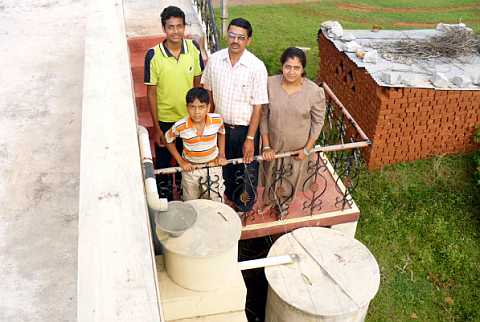
Ramesh' family near their drinking (rain) water tank. Pic : Shree Padre.

The corporation borewell is not far away from this house – within 150 metres. Recently, to prevent water logging in the front portion of this row of houses, a bund was constructed. Ramesh notes, “After that, in the monsoon, our corporation supply is a little less hard. But come summer, the hardness increases.” However, a plea to arrange for artificial recharge of this borewell has fallen on deaf ears.

Teams that come to Mysore city for training in rainwater harvesting invariably pay a visit to this house. “But some of them don’t have interest in the concept at all. A few don’t even get down from the vehicles. Some others inquire about many other things like our aquarium, ornamental plants, etc. If rainwater is offered to drink, some people refuse saying they will catch a cold,” says Vani. “There were occasions when I reacted to such visitors that you would happily drink water from unknown sources where even a buffalo might have been washed. But you hesitate to drink such good and safe water.”

But people like Dr Mrutyunjaya on the other hand were very impressed. He has arranged to store 14,000 litres of water. Since the last two seasons this family too is happily using rainwater.

Though all the family members explained about the seriousness of the hardness of the public water supply here, photos showed by Ramesh really amazed me. Pointing out to a photo of a bucket full of scales he said, “This is the deposition in my 500- litres tank in three and half years. I took out four such bucketful of scales.” That means about 40 lutes of scales in 42 months! In the neighboring Roopnagar area, reportedly the water is still harder.

After my return, Ramesh called me over telephone. He was sorry that he forgot to give me a tumbler of corporation water to taste. Of course, I had tasted their rainwater that was as tasty as well water in my village. Looking at the photos of bucketful of scales in my computer, I replied, “I have no regrets, Ramesh.”

Shree Padre
8 Oct 2008

Shree Padre is a journalist with many years of experience in agricultural reporting. He is the author of several books, including one on rainwater harvesting, published by Altermedia.

H Ramesh can be contacted at hebbale AT gmail DOT com.

 •  Write the author
 •  Post a comment on this article
 •  Environment
 •  Karnataka
 •  Reprint permissions

Comments (13)

  • Posted by Dr N B Shridhar,

    The article is good. Shree Padre is doing good job since many years through Adike Patrike.

  • Posted by Dr.V.Satyanarayana,

    Sri Ramesh and his family deserve
    appreciation for the skills they had adapted in harvesting the gift(health)from the sky.Drinking rainwater shall solve several waterborne diseases .In developing country like ours children mostly suffer from water borne diseases ,Their concept is worth emulation by every educated person whenever he goes for his house construction
    I wish our Governaments should insist for such provision in the building plans before they are approved.

    .

  • Posted by Raghavendra,

    I have visited Mr. Ramesh's home several times and has been lucky to see his visionary work during the initial stages.

    I pledge to have the similar plan to my home whenever i build one of course with the help of Mr. Ramesh!!!

  • Posted by Lokesh,

    Rain water harvesting.. Many people think its some Hi Fi technology.. But the theme is very simple..
    "Not letting the water to go waste".

    I had a talk with Ramesh sir and Dr.Mrutyunjaya (JSSH) sir about this Rain Water Harvesting. Its really an efficient method. It saves us and materials from Hardness in water. Most of us think rain water will not be sufficient, how much of rain water can we catch etc.. But Ramesh sir has shown them in a practical way that its possible.

    I find 2 difficulties in implementing this in a large scale..

    1) Area required: Independent houses with more area, school college university campus and hostels can implement this easily. But now the real estate prices have gone so high that many people are purchasing Flats. Here it can be implemented but its not sufficient for the people living in Flats. But still that water can be stored and used for some other specific needs.

    2) Air Pollution: Since Our Mysore is not so polluted, this RHW is having pleasant effects on health and objects. But the places where the pollution is high, the gasses will make the water acidic and results in many adverse affects especially in the long run and may need special water treatment to make the water potable. So it is better to Avoid RWH in High Air pollution areas unless the domestic water treatment units or other methods are available.

    So if you have area in non polluted places Please implement RWH as early as possible.. If not, look for the other alternatives.

    Now a days the KEB has made Solar water heaters mandateory for getting new electric connections in some places. I think even this RWH also should be made mandatory in feasible places.

    I Congradulate Ramesh Sir for showing RHW is very much successful both in implementation and utlization..

  • Posted by Rekha Pradeep,

    Dear Vani and Ramesh,
    You deserve a big applause! Hats off to you. Never thought that we could make use of rain water. We will definitely use your technique when we settle down in India.

  • Posted by Prakash M Apte,

    Such solutions are possible only while living in independent houses with a large open area around. Not to belittle such efforts, what we need however is a system that can work for multistory housing in metropolitan cities

    Prakash M Apte

  • Posted by vikram patil,

    This letter is very impressive, economical and also environmentally safe. i thik this method of rain water harvesting should be made strict mandetory for all people where there is water scarcity by the govt. and I request you to send praposal regarding this to govt.

  • Posted by sham,,

    Good work by Ramesh and his family.
    I have visited their house and I felt very happy by seeing the RWH system.
    Let many more people adopt the RWH scheme's.

    Let us all join hands for the cause of Conserving water.

    sham,
    NIE-CREST,
    Mysore.

  • Posted by Ravi Bharadwaj,

    Dear Ramesha & Vani,
    It is nice to see your article on rain water harvesting and I am really proud to have friends like you who have understood the problem and are practicing the usage of rain water.On my visit to Mysore I had seen personally and appreciate the efforts and as a Hydrologist I further assure all the users of safe and healthy drinking water.Please remember every drop of water saved is water conserved.

  • Posted by V.MURALIDHARAN,

    It is really amazing!!!...Bravo to Ramesh and Vani family. It is a lesson to every Human being how to save the God's gifted water. If I visit Mysore it would be my duty to pick up my wards to Mr.Ramesh's house to show their plants.

  • Posted by Jagadish C N,

    Good work done by Sri Ramesh and Smt Vani. However to implement such type of RWH we should have enough space.

  • Posted by Chandra,

    Mr.& Mrs.Ramesh did a realistic job. Its a great help/guidence for people who wish to save enivironment & live healthy.

    And many more thanks to India Together for the publication of their efforts

  • Posted by Bhavna Agrawal,

    Rain water harvesting..it is such a great idea.It saves us and materials from Hardness in water. Most of us think rain water will not be sufficient, how much of rain water can we catch etc.. But Ramesh sir has shown them in a practical way that its possible.
    but i found 2 problems in implementing this technique at a large scale

    1. for this activity we need more space. as if we talk about people living in flats it is just impossible for them to implement this idea. But schools and colleges can take help of this and can avoid water problems and can use water resources with low prices.

    2.As we all know the problems of air pollution so it would be difficult to save the water from the effect of air pollution and the acids will effect water and this will lead a negative impact.


Post a comment
Note: Your comment will appear within 24 hours unless found inappropriate (spam, netabuse).
See policy


Note: If you do not wish to post a public comment here and instead want to write a letter to the author directly, use the Write the author link that follows the author's byline at the end of the article.


Remember personal info?


For verification, please enter the security code you see below


View posted letters (13)
Note: Your post will appear within 24 hours unless found inappropriate (spam, netabuse). See policy

Comments powered by Movable Type 2.64 


In India
India Together
1677, 17th Main
JP Nagar II Phase
Bangalore
560078
Outside India
India Together
PO Box 26254
San Diego CA 92196
USA

Charge to your credit or debit card using the secure e-payment gateway of PayPal from anywhere.
Contribute now

HDFC Bank
Account Number 01332000003849
Account name: Civil Society Information Exchange
Account type: Current A/C
J P Nagar Branch, Bangalore
IFSC code: HDFC0000133

Articles in related topics
ENVIRONMENT
- Gas clouds over the govt.
- The wrecking sand dunes
- Exempt, but not exempt
- Red flags over green tribunal

KARNATAKA
- Once bitten, twice not shy
- Put in water, take out guarantee
- Softening hard water with rain
- The gift from the sky


free public affairs ads. (join).


RECENTLY IN INDIA TOGETHER
 •  Our view, their view, the world-view
 •  Where Suvarna Jala fails, schools leap ahead
 •  CIC: Jobs for the boys
 •  K Balagopal - The honest leftist
 •  Running wild with the Biodiversity Act
 •  Film review: The spoofs of Malegaon
 •  Between a village and a town
 •  Rain pond to the rescue
 •  Making ends meet, in the wake of the Narmada dam
 •  GM crops: Where is the science?
 •  Nobel for ostrom: Are Indian policy-makers listening?
 •  Varanasi weavers get GI protection
 •  1984 - Twenty five years later
 •  Bundelkhand - Living with drought
 •  A Kerala land struggle is settled, questions remain
 •  In TN, poor parents pushing children into English schools
 •  Lakshmibehn's legacy of loss
 •  Need to strengthen climate diplomacy
 •  Narmada refugees: Living on the edge
 •  A miner's shortcut to green clearance goes awry
 •  Electricity Act: The power to protect rivers
 •  A job for an infantryman
 •  Study the impacts first, says Delhi HC
 •  Film review: Hope dies last in war
 •  Sainath: The winter of our austerity
 •  Guha: The beauty of compromise
 •  A limited 'tribute' to an unlimited legacy
 •  Emissions of the rich and famous
 •  Narnaul - Saved by the women
 •  How not to remember Bapu


© Civil Society Information Exchange Pvt. Ltd., all rights reserved.
Home | About us | Overview | Support | Contact Us | Disclaimer