




INDIA TOGETHER
 Wed 25 Nov 2009    The news in proportion.
NEWSLETTER
DIGITAL EDITION
PLEASE CONTRIBUTE
HOME OPINIONS SEARCH SUPPORT
NEWSLETTER
AGRICULTURE
Agriculture issues page
GE/GM
Hunger
Links
Livestock
Opinions
Organic
Policy
Trade

RSS Feeds 
 
SERVICES
Advertise
Contact Us
Newsletter
Submit

AGRICULTURE
Natural farmers of Punjab
During the last four to five years, the soil in several parts of Punjab has been regenerated and rejuvenated. Natural farmers are convinced it is working. The movement is led by experienced farmers who believe in Guru Nanak's tenet of Sarbat da bhala (well being of all). Umendra Dutt writes about the transformative work hundreds of farmers are doing.

 •  Write the author
 •  Agriculture
 •  Punjab
 •  Send to a friend
 •  Printer friendly version
1 November 2007 - There is a silent and constructive revolution happening in Punjab to save the environment, regenerate ecological resources, bring back soil productivity and re-establish ecological balance in the farms. This is the natural farming movement of Kheti Virasat Mission (KVM), a civil society action group headquartered in the Jaitu town of Faridkot district. The movement is led by experienced farmers who believe in Guru Nanak's tenet of Sarbat da bhala (well being of all)," says Amarjeet Sharma, a farmer from Chaina village, district Faridkot who heads the village level Vatavaran Panchayat. Vatavaran Panchayats are local-level community institutions working as decentralised participatory civil society initiatives.

KVM is a farmer membership organization with some formal and mostly informal members. Informal members are farmers who work with KVM through its Vatavaran Panchayats. KVM farmers take pledges to start natural farming in one go or in a phased manner. KVM currently has around a 100 formal and 800 informal members.
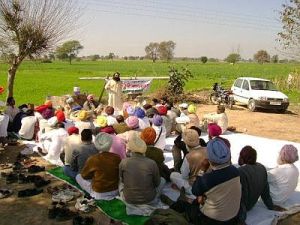
A natural farming workshop. Pic: Ajay Tripathi, Kudrati Kheti archives.

The practitioners of this 'natural farming' are not environmentalists, economists, or religious preachers. They are not even agricultural experts or health professionals. But the wisdom these natural farmers possess and practice combines the knowledge of all these. KVM preaches its farmers to adopt the famous verses from the Guru Granth Sahib, Pavnu Guru, Panni Pita Matta Dharat Mahat (air is guru, water is father and the earth is mother). One can call this farming with passion, spiritual farming, natural farming, non-violent agriculture or simply Nanak Kheti.

Natural farmers of Punjab say that the land has witnessed the destruction of the environment and particularly the soil ecology in the last few decades as a consequence of chemical intensive farming. The soil has lost its nutrient pool. Burning of paddy straw has further destroyed the soil's health.

But during the last four to five years, the soil in several parts of Punjab has been regenerated and rejuvenated, these natural farmers are convinced, so much so that your feet feel happy and healthy on coming in contact with the soil. You can see earthworm castings, which had completely disappeared in the fields, says a visibly happy and proud Hartej Singh of Mehta village in Bhatinda district. "Our farmers will offer you a handful of soil which you will find soft and with all the natural aromas that are associated with the infinite life of our earth. That is the kind of work we are doing," he adds.

The practitioners of this 'natural farming' are not environmentalists, economists, or religious preachers. They are not even agricultural experts or health professionals. But the wisdom these natural farmers possess and practice combines the knowledge of all these.


 •  New terms of harvest
 •  Sorrow, thy name is Jajjal

KVM has evolved a distinct philosophy which defines soil as the 'source of infinite lives'. "Yes, it is true and we have experienced it," avers KVM chairman and a farmer from Rai Ke Kalan village of Bathinda, Harjant Singh. If the soil is rich in microorganisms, its texture is soft, full of natural essence and ample quantities of moisture are kept intact. Then the soil gives healthy crops, and there is a lesser need for irrigation.

Harjant Singh further elaborates on the scientific premises of natural farming. All living organisms require nutrition and minerals for their growth, and amongst them plants, being stationary, get their nutrition at that spot. They get carbon dioxide and water from nature and by the process of photosynthesis, the required amount of sugars is produced. Similarly nitrogen is available in the air and the rhyzobia bacteria in the soil can capture it for the plants. These microorganisms perform different functions for the plants. "By using the chemical inputs, especially the pesticides, we have destroyed the delicate microbial equilibrium of soil and tilted the game in favour of external chemical inputs thus making the situation even worst," says Singh.

KVM farmers use Jeevaamrita (a cow urine based microbial preparation) to revive microbial activity in soil. With the application of Jeevaamrita and Ghan Jeevaamrita (a solid form of Jeevaamrita), the soil is gradually becoming rich in the humus, yield has increased and other life forms are coming back in the fields, says Charanjeet Singh Punni, another KVM farmer from Chaina village and a natural farming trainer. Punni highlights another aspect of natural farming. "Although the sunlight of some of its radiation is essential for the photosynthesis, yet it is a threat to the soil bacteria. Mulching is the best answer to this."

Mulching is an essential part of natural farming. Natural farmers aver that when the soil is covered with various forms of mulching, the results are unimaginable. Earlier the soil had lost all soil bacteria, microbes and earthworms. But after adoption of Jeevaamrita and mulching, the farms are again becoming wealthy in soil health. Krishnan Jakhar of village Dhaba (near Dabawali), Vinod Jyani of village Katehra and other natural farmers of the KVM network are using inter crops, plant residue, fallen leaves, bushes, weeds and sometimes even the wheat straw or the rice straw cuttings spread in the fields to cover the naked soil. Besides protecting the bacteria and retaining the moisture, this also keeps the temperature of the soil low and it never goes beyond the 40 degrees Celsius, which is the upper limit for the survival of microbes, tells Ajay Tripathi, associate director of KVM.

KVM farmers have redefined, reestablished and regenerated their mother-son relation with the soil. They feel a spiritual bond, a oneness with the soil. That is why they are against all forms of agro-chemicals and burning of fields - to them it is a form of violence against the earth.
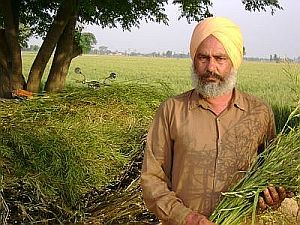
Amarjit Sharma, farmer at Chaina village. Pic: Ajay Tripathi, Kudrati Kheti archives.

Does the economics work?

This spiritual soil science is also more financially beneficial to these farmers. After adopting natural farming they are spending far less from earlier chemical farming days. Natural famring is more cost effective and input efficient says Amarjeet Dhillon a small farmer from Dabrikhana village, who owns only two acres of land. For example, farmers having sugarcane and black gram in their farms have to spend virtually nothing on inputs asserts, Dhillon. He cities several examples where farmer had spend only Rs.100-200 on inputs for one acre as against Rs.3000 by a chemical farming farmer. "Some of us had stopped cash out flow to cities any more to purchase Urea, DAP and pesticides and thousands of others have reduced this out flow of cash in a big way", he adds.

On an average in Malwa's cotton belt farmers are spending Rs.7000 on chemical inputs per acre annually in normal conditions. If there are more pest attacks, then there may be no limit to this amount. There is a rough estimate that every village is spending a large sum of money -- from Rs.40 lakhs to Rs.6 crores -- purchasing agro-chemicals, depending upon area of cultivation and cropping pattern. Natural farmers want to stop the loss of village wealth by bringing down farmers' spending on agro-chemicals.

The list of natural farmers includes names from all corners of the state. The Pingalwara Charitable Society, Amritsar, a prestigious social service institute in north India, founded by Bhagat Puran Singh has joined natural farming and is supporting the movement with its resources. Pingalwara has established the Bhagat Puran Singh Natural Farming Centre in 37 acres at village Dhirakot near Jandiala Guru. Similarly many professionals such as those from the medical field, college and university lecturers and professors, advocates, even government officials and civil servants have joined this movement for rejuvenation of the soil. They are in contact with the KVM and participate in its activities.

In the just commenced wheat season -- from now to mid-April -- KVM activists are planning to reach out to at least 60 blocks of the state. These activists are farmers who work in the fields, not experts who come by when they can spare time to propagate natural farming. They are trainers, scientists and leaders of this ecological initiative, in the service of mother nature.

Umendra Dutt
1 Nov 2007

Umendra Dutt is Executive Director at the Kheti Virasat Mission, Bishnandi Bazar JAITU, 151202, District-Faridkot, Punjab. Phone: 01635-503415.

 •  Write the author
 •  Post a comment on this article
 •  Agriculture
 •  Punjab
 •  Reprint permissions

Comments (15)

  • Posted by meenakshi Srinivasan,

    Thank you so much for this article. You have no idea how thrilled I am to read this. I sincerely hope this knowledge will transfer all across the nation and finally the world.

  • Posted by P.Narasimha Reddy,

    Congrats for this wonderful piece of information from the land of so called mother of GREEN REVOLUTION.
    Yes Nanak Kheti works.Pioneers inthis field under Guru Subhash Palekar the proponent of O Budget Natural Farming have proved it substantially in many parts of Karnataka,Maharashtra and now in AP.
    If it works in North and South it can as well work in East and West.
    Long live Kheti Virasat Mission.
    KUDOS

  • Posted by Laxmi Narayana Paladi,

    Dear Sirs,
    Kheti Virasat Mission is a good begining. The entire country and the whole World needs to go towards this direction. This should lead the farmers to
    1) to conserve and utilise the last gram of urine and dung of the cattle sheeo and goats and divert it to farms after necessary composting.
    2) All copostable organic matter should go for composting on scietific lines without wasting a single gram.
    3) Burning of valuable trash should be stoped at once.
    4) Intensive tree plantation should go in a fastest manner.
    5) Green manure production and usage must be 100% intensified.
    Laxmi Narayana Paladi
    306, Sowmya Apartments(East),
    Hudacomplex, Saroor Nagar,
    Hyderabad AP, 500 035,
    Presently at California

  • Posted by Ravindran,

    This is a very good development especially coming after so many disheartening news items relating to farmer indebtedness and suicides. Can I have details of the Jeevaamrita which is referred in the article.

  • Posted by v. premnath,

    Non violent Agriculture is a beautiful synonim for natural agriculture. Most apt and relavent to present.

  • Posted by L.C.Nagaraj,

    Thank you sir,its a timely article.Organic soil remediation the only way out to conserve the ecosystems farmers livelihoods and the escalation of human diseases.Thanks for the timely article.
    Regards
    L.C.Nagaraj

  • Posted by Dr. Arup Kumar Deka,

    Sir,
    Natural farming is the need of the hour. To sustain the agricultural productivity the use of chemical inputs should be reduced substantially, there is no doubt about that. Generation of awareness in this respect has to be intensified. This article is a right step in this regard.

    Dr. Arup Kumar Deka
    Assistant Professor
    NERIWALM
    Tezpur-784 027

  • Posted by Dev Kumar Dutta,

    Congratulations on your success and best wishes for the success of your mission. Ideally you should look beyond Punjab which I'm sure you've contemplated. It's good for the country.

  • Posted by Dilip Dhaker,

    The name itself suggest the mission to save the earth and return to ancestors way of farming with the value added techniques.This is a begining,in Maharastra also nearly 20,ooo farmers are engaged in the organicc Agriculture practices and benefiting the soil,enviroment and themselves as there are lot of buyers for the organic producers ,as I m experiencing it from the next 4 years
    Pune ,Maharastra-09423036804

  • Posted by GK,

    Nanak Kheti...
    Wow. The name is so appropriate. After completing his journeys in 4 directions, Guru Nanak Sahib started sustainable farming in KartarPur involving the community, feeding the hungry and baselining the Langar Tradition. Thank you KVM for reviving natural farming in the land exploited by the government for centuries.

    GK

  • Posted by Rajani Ch,

    A very encouraging article. Thank you!
    Does any one know where we can purchase organic clothing in India? Next big thing is going to be a line of organic clothing with awareness slowly rising.

  • Posted by Mandeep Nagra,

    This is the right step in the right direction.It is healthy for the soil, more eco friendly, less expensive and most of all less toxic to the ground water. There has been a record number of esophageal, breast, stomach ,bladder and pancreatic cancers reported from Punjab and Haryana. This is very likely from the use of toxic chemicals and toxic industrial waste that is contaminating the ground water. I read an article in the Tribune that some farmers in Punjab play music and thta also classical indian music in their fields twice a day for 2,3 hrs at a time and they have noticed increased production per acre. The developed countries and teh bureaucrats promote fertilisers, pesticides by spending milions on the advertisements. We need to adopt crop rotations, use the best quality seed. We should store the rain water and use drip sytem for irrigation. Mulching definitely helps in a big way to conserve moisture, conserve ground temperature and promote soil quality by helping preserve microorganisms.

  • Posted by venkatesan,

    My salutes to SUBASH PALEKARji & KVM we assure that we all will follow this farming method & give healthy products to the consumers i attended the class of palekarji in coimbatore last four days & came to know a lot about NATURAL FARMING.
    The key for success in farming is BIJAMIRTHA,GHANAJEEVAMIRTHA,JEEVAMIRTHA,NEEMASTHRAM,AGNIASTRAM,BRAMHASTRAM.
    JAIHIND

  • Posted by Sundaresan A,

    I attended seminar conducted at Tanjore by Palekar, It is good and right step. I hope there will be definitely revolution in the natural farming particularly in the south india. There is tremendious response from the farmers to attend the sessions and to do practice in their fields. In withing 2-3 years most part of the fields will be sifted to natural farming shortly
    A.Sundaresan, AEE (RD), Vellore

  • Posted by Harish,

    I invite all the farmers of KVM to join as host of wwoof india , by doing so they will get eco volunteers to work in their organic farms in exchange of food and shelter . For more details visit our website www.wwoofindia.org

    Harish

    wwoof india coordinator


Post a comment
Note: Your comment will appear within 24 hours unless found inappropriate (spam, netabuse).
See policy


Note: If you do not wish to post a public comment here and instead want to write a letter to the author directly, use the Write the author link that follows the author's byline at the end of the article.


Remember personal info?


For verification, please enter the security code you see below


View posted letters (15)
Note: Your post will appear within 24 hours unless found inappropriate (spam, netabuse). See policy

Comments powered by Movable Type 2.64 


In India
India Together
1677, 17th Main
JP Nagar II Phase
Bangalore
560078
Outside India
India Together
PO Box 26254
San Diego CA 92196
USA

Charge to your credit or debit card using the secure e-payment gateway of PayPal from anywhere.
Contribute now

HDFC Bank
Account Number 01332000003849
Account name: Civil Society Information Exchange
Account type: Current A/C
J P Nagar Branch, Bangalore
IFSC code: HDFC0000133

Articles in related topics
AGRICULTURE
- Farmers sour on sugarcane
- ASEAN FTA: A hasty deal
- Too risky to tolerate
- Dull days of White Gold


free public affairs ads. (join).


RECENTLY IN INDIA TOGETHER
 •  Our view, their view, the world-view
 •  Where Suvarna Jala fails, schools leap ahead
 •  CIC: Jobs for the boys
 •  K Balagopal - The honest leftist
 •  Running wild with the Biodiversity Act
 •  Film review: The spoofs of Malegaon
 •  Between a village and a town
 •  Rain pond to the rescue
 •  Making ends meet, in the wake of the Narmada dam
 •  GM crops: Where is the science?
 •  Nobel for ostrom: Are Indian policy-makers listening?
 •  Varanasi weavers get GI protection
 •  1984 - Twenty five years later
 •  Bundelkhand - Living with drought
 •  A Kerala land struggle is settled, questions remain
 •  In TN, poor parents pushing children into English schools
 •  Lakshmibehn's legacy of loss
 •  Need to strengthen climate diplomacy
 •  Narmada refugees: Living on the edge
 •  A miner's shortcut to green clearance goes awry
 •  Electricity Act: The power to protect rivers
 •  A job for an infantryman
 •  Study the impacts first, says Delhi HC
 •  Film review: Hope dies last in war
 •  Sainath: The winter of our austerity
 •  Guha: The beauty of compromise
 •  A limited 'tribute' to an unlimited legacy
 •  Emissions of the rich and famous
 •  Narnaul - Saved by the women
 •  How not to remember Bapu


© Civil Society Information Exchange Pvt. Ltd., all rights reserved.
Home | About us | Overview | Support | Contact Us | Disclaimer