





Ask about katta and any knowledgeable person in Kasaragod district would name one Yethadka. This sleepy hamlet in Kumbdaje village of Kerala is bordering Karnataka State. Today Yethadka has become synonymous with kattas, the traditional check-dams that farmers construct across rivulets to store water. Kattas are temporary structures. They have to be dismantled before monsoon to make way for the gushing run-off. (Kumbdaje village is a revenue village containing a cluster of hamlets like Yethadka.)
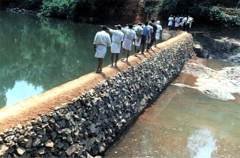
 Keerikkaadu katta (check-dam) near Yethadka.
Arecanut is the main cash crop of this district. Decades ago, thousands of kattas were being constructed in this part of the district, without seeking government support. Locally available material like kachcha stones and mud are used in construction. There is no dependence on cement or other inputs from the city. It is with this rivulet water checked by kattas that most of the arecanut gardens are irrigated.
Each village had expertise in katta construction. But with the arrival of electricity, irrigation pumpsets, bore-well drilling machines, etc., this practiced has almost vanished elsewhere. In some of the villages today, like Meenja, Peradala and Padre, even if they want to, they are not able to build kattas for want of the skill locally.
"Katta was part and parcel of our culture during our time," recalls Professor G R Rai, retired Principal of Vivekananda Engineering College, Puttur. So important were these water conservation systems that many farmers' families are named after kattas. Kallakatta, Kattada Korikkaru, Katta, Kattadamoole, Kattaththadka, Kattada Mane, Kattahithlu are some examples.
Rejuvenation led by campaigner
It is his obsession with kattas has earned Chandrashekhar Yethadka a new name among his close circles: Chandrashekhar Katta. His own family currently shoulders the leadership of building a katta at nearby Padyadka. Also a freelance journalist, in mid-nineties he conducted a survey of local water situation for a farm magazine. The revealing data he collected got him thinking. Recalls he, "The bore wells dug in the near past had not provided water security. Instead, they made the situation worse. Fed up, some farmers had already started reverting back to traditional systems." The survey turned Chandra into a staunch campaigner of kattas.
As one strategy, he started writing features in a local magazine. Organising one-day workshops on kattas was another strategy. Roping in the support of the local Farm Information Exchange Club and like-minded farmers in between 2000 and 2004, Chandra organised three workshops on kattas. Farmers went on a jalyatra from katta to katta and shared their problems and experiences. Though it might look as trivia to others, there were many technical problems to be addressed too, like the damage caused by crabs for example. Veteran water conservationists like T N N Bhattaththiripad, Terry Thomas, and Kanavu Gopalakrishna Bhat, etc., were invited as guests to these meetings.
The workshops and media light facilitated a lot of interaction between the farmers. As one of them put it, "We meet on many occasions, but seldom discuss about katta. When all of us sat with one objective, that is only to discuss about kattas, the outcome was fruitful and we got some solutions to our problems, and above all, a renewed spirit."
The flow in the rivulet goes on diminishing after the late rains of October-November. But as long as the water-flow is strong, no one can venture raising a check-dam across the flow. They have to wait. But for how long? If they wait too long, it may be too late.
As a result of thorough back-study of a decade's data maintained by N N Bhat, if kattas are constructed later than 15 December, they don't get fully filled, that is, upto the brim.
 Developing a mutual communication system had many positive
advantages. Many important research and development measures came out of the workshops.
Introduction of sand-bag check-dams is one important among them. Planning the right
time and priority of order in katta construction dates is another. As per a decade's
data maintained by farmer and retired teacher Nandrodu Narayana Bhat, if the katta
construction is finished before 15 December, it gets filled to the brim. Even a small
delay of a week would be reason enough for the failure of filling. Secondly, only if
the rivulet's upstream farmers construct the katta in time, it is beneficial to farmers
downstream. Delay in construction upstream, results in stoppage of overflow (of water)
from the upstream to downstream in the rivulet.
Developing a mutual communication system had many positive
advantages. Many important research and development measures came out of the workshops.
Introduction of sand-bag check-dams is one important among them. Planning the right
time and priority of order in katta construction dates is another. As per a decade's
data maintained by farmer and retired teacher Nandrodu Narayana Bhat, if the katta
construction is finished before 15 December, it gets filled to the brim. Even a small
delay of a week would be reason enough for the failure of filling. Secondly, only if
the rivulet's upstream farmers construct the katta in time, it is beneficial to farmers
downstream. Delay in construction upstream, results in stoppage of overflow (of water)
from the upstream to downstream in the rivulet.
After this valuable info was made public in a workshop 2 years ago, farmers groups have accepted it and are being benefited. If finished by 15 December, the kattas get filled to the brim, in around 3-4 days to a week. After this, areca farmers start pumping out water. Still, the problem of upstream farmers finishing katta construction after their downstream counterparts remains to be resolved fully. There are practical problems in smoothening this 'right order of construction'.
Check-dams are popular here
The Kumbdaje Panchayat covers an area of about seven square kilometres. It has one river and 20 thodus (rivulets) that put together have a combined length of 37.5 kilometres. Today 24 kattas are constructed in Kumbdaje village alone. As noted earlier, kattas are temporary structures. The recurring annual expenditure is around 3 lakh rupees and is borne by about 200 farming families. (1 lakh = 100,000)
Berkadavu Katta, the biggest, required an expenditure of Rs 49000 this year. It holds about 12 crore litres of water. The total extent of an areca garden that is irrigated by this katta amounts to 35 acres belonging to 12 families. At a modest estimate, the value of agricultural produce generated from these gardens comes to about 25 lakh rupees annually. (1 crore = 10 million)
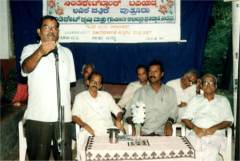 A Katta workshop at Berkadavu Seetharama Bhat's house.
The most important aspect of kattas is that it is constructed with people's participation. Each katta has about 5 to 15 beneficiary families. They share the cost of construction. Generally, one family takes up the responsibility of construction and management. Others contribute in cash. The water is shared.
Kasaragod is a heavy rainfall district enjoying an annual rainfall of 3,500 mm. The topography is undulating. Situated close to sea, it has lateritic soil. Though the main benefits of kattas go to the arecanut gardens situated on both the banks, kattas also indirectly help in maintaining the level of water in the nearby hillocks. Thus they aid in enhancing drinking water availability for families living on upper portions of the hills. This way, kattas augment water and moisture levels in a vast locality. In the process, they help in ground water recharge too.
"Kattas form the life-line for our livelihoods. We won't have an existence without them," says Dr Lingappa Shetty, an elderly farmer in his early-seventies. "Like the Bijapur farmers who keep coming to our area in search of work, we too would have to migrate elsewhere if we forget kattas. A few farmers are confident that they have bore wells. But if the bore well has to provide them water, we need kattas."
Proven but unrecognised
"Yet," complains Chandra, "neither the Grama Panchayats nor the governments have taken these jalanidhis seriously. They take it for granted. Government's water conservation awareness programmes conspicuously ignore kattas. In fact, rest of Kerala, or for that matter, our own administration has never tried to understand the importance of kattas vis a vis borewells." (Chandra is referring to the panchayat, district administration and watershed departments.)
In Kumbdaje village alone 11 vented cross-bars -- a type of permanent cement check-dam, the vertical wall of which has to be erected either by wooden planks or soil or a mixture of both -- have been constructed during the last 10-15 years. These cement structures have been constructed in place of temporary check-dams (kattas) to 'help the concerned farmers'. The cost of these is between 5 to 10 lakh rupees each, and the Minor Irrigation Department of Kerala funded these structures. So at least half crore rupees have been spent on these cement check-dams. Unfortunately, with the exception of 3 or 4, the others are failures. Points out Chandra, "for putting checks in these vented cross bars, they give around Rs 30,000 every year by way of contract. Instead, if this money is given to the beneficiary, the workmanship would be superior." Failure of these modern check-dams warrants a thorough study by experts.
Chandra says that the local watershed department even recommends some structures like brushwood dams that are not suited to local conditions. "But why do they totally ignore such a wonderful traditional system like katta that ensures peoples participation and water security?" he queries.
Interestingly, Badiadka and Madhur grama panchayats are providing small cash incentives for katta construction. At Badiadka, they pay Rs 4000 for small kattas and Rs 8000 for bigger ones. This support, though small, has prevented farmer-groups by bidding good-bye to katta construction.
Inspiring others, uncovering truths, crossing borders
Yethadka, despite odds, is providing inspiration to many farmer groups. Idkidu, a village in Puttur taluk of neighbouring Karnataka, has increased its number of kattas from earlier 1 to 17. Dr V Krishnamoorthy of Varanashi Research Foundation was impressed by the community spirit at Yethadka. He has now innovated an easier method for katta construction. In place of mud, he incorporates a Silpaulin sheet that reduces the headache and labour of construction. This type of check-dam, named as Varanashi katta, is being successfully followed by seven other farmer-groups now in Buntwal taluk and the adjoining Puttur taluk. (Several Karnataka districts had thousands of kattas decades ago. The number has shrunk steeply now. In other districts, kattas are less known.)
Dr V V Ramana, a young doctor and farmer from nearby Mulleria, also took inspiration from Yethadka and started constructing a katta two years ago. "Because of this I could bid good-bye to the idea of digging a bore-well," he says proudly. His neighbour who objected initially fearing that the new katta would not allow water-flow downstream is now convinced. He too has started constructing one now. These kuchcha structures don't check the water totally. Water starts seeping from below and side-ways and as such downstream flow is not affected. Points out Paththadka Ganapathy Bhat, "the interesting truth about kattas is that the downstream farmers would be benefited only if there are a series of kattas at the upstream."
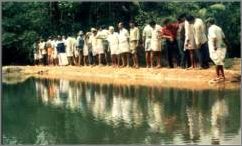 Group of farmers visiting katta after katta in a jalyatra in April 1999.
Even at Yethadka, the Mecca of Kattas, points out Chandra, out of the combined rivulet length of 37.5 kilometres, kattas are erected in only a stretch of about 8 kms. This makes a mere 15 per cent. Panchayat statistics says that 43 per cent of land out of the total area of 7684 acres is dry, i.e., without any cultivation. At the same time, more than 80 per cent of water from their rivulets is directly flowing to the sea without being utilised!
Manoj P Samuel, Technical Officer, Krishi Vijnan Kendra, Kasaragod, has studied the technical and social aspects of kattas in detail. KVK is a district-level organisation setup to extend appropriate farm technologies from lab to land. Kattas are quite cheap as compared to other modes of rain harvesting or water conservation, says Samuel. Referring to Berkadavu katta in Kumbdaje, he says: "Through kattas it takes only 41 paisa to conserve one metre cube (1000 litres) of water. This is quite cheap when you compare it to other methods of water harvesting or conservation."
It is not surprising that batteries of academic researchers, visitor and farmers' groups keep coming to Yethadka to study kattas. Important among them are from Indian Institute of Management, Kozhikode, Centre for Water Resources Development and Management, Kozhikode and Mangalore University, etc. Still, researchers have not been closing the loop with the farmers. "We co-operate with these researchers whole-heartedly. But despite promises, none of them have shared a copy of their study reports to us," complains Kaleyaththodi Shyam Bhat, another farmer.
Meanwhile, Badiadka Panchayat's cash incentive has heightened the spirit of farmers towards kattas. This year, the panchayat has seen 24 big and 31 smaller kattas coming up. According to a guesstimate, around 500 kattas are still being constructed in Kasaragod district. Provision of cash incentives coupled with consistent awareness campaigns would prompt more and more farmers to follow suit. In neighbouring Karnataka, there is very high potential for building such low-cost kattas in rainfall districts like Dakshina Kannada, Uttara Kannada, Shimoga, Chickmaglore and parts of Hassan. More kattas utlimately mean less dependence on bore wells and decrease in water scarcity.