




INDIA TOGETHER
 Wed 19 Nov 2008    The news in proportion.
NEWSLETTER
DIGITAL EDITION
PLEASE CONTRIBUTE
HOME OPINIONS INTERACT ABOUT US SUPPORT SEARCH
HEALTH
Health issues page
AIDS
Children
Disability
Env. Hazards
Laws
Mental Health
Population
Public Health
Sanitation
Women

RSS Feeds
SERVICES
Advertise
Contact Us
Newsletter
Submit

 •  Write the author
 •  Health Hazards
 •  Mining
 •  Spread the word
 •  Printer friendly version
HEALTH HAZARDS
White asbestos, a health time bomb
The Ministry of Mines and Minerals says it may lift the ban on asbestos mining. It is ignoring the views of exposure victims, informed recommendations of public sector medical experts, and mounting evidence of an asbestos disease epidemic emerging in developed countries. The rationale to permit mining is hollow, writes Gopal Krishna.

12 April 2006 - Unexamined in the media, workers in India work up to their knees in asbestos powder, breaking up asbestos cement roofs and pipes. Stories of the toll asbestos takes on people are yet to hit the headlines in India as been the case in US, Europe, Australia and Japan. Indian homes are often built of asbestos cement roofs, and people cut their own windows and doorways. Research is showing asbestos epidemics across the globe even in countries where it is currently banned, as the consequence of past exposure, with estimated deaths reaching 30 per day.

The International Labour Organization said in January 2006 that asbestos is still the No.1 carcinogen in the world in its report titled "Asbestos: the iron grip of latency." It adds, the dumping of asbestos on developing countries will "prove to be a health time bomb in these countries in 20 to 30 years' time." Jukka Takala, Director of the ILO InFocus Programme SafeWork, issued the report.

Asbestos is the generic term for a number of naturally occurring fibrous minerals. Commercially, the most important of these are the white, blue, and brown varieties, otherwise known as chrysotile (a serpentine asbestos), crocidolite, and amosite. Blue and brown variety of asbestos are banned in India.


 •  Fibres of subterfuge
 •  Fibres of misinformation

While white asbestos mining is currently banned in India, its import, export or use in manufacturing is permitted. But recently, the Ministry of Mines has indicated that it may lift the mining ban.

The reality is that the country's most powerful parliamentarians bless the asbestos industry. On 1 January 2006, production began at an asbestos-cement factory in Rae Bareli, Uttar Pradesh, in the constituency of Sonia Gandhi. The factory is of Visaka Industries, one of India's largest asbestos groups. The company also has asbestos-cement factories in Andhra Pradesh, Tamil Nadu, West Bengal and Karnataka. The Chairman of Visaka Industries, G Vivekanand, is the son of the G Venkataswamy, Member of Parliament, Deputy Leader of the Indian Congress Parliamentary Party and a former Union Textile Minister.

Visaka Industries has asbestos plants located even in Midnapore in West Bengal where CPI(M) is the ruling party for more than 25 years. Although Centre of Indian Trade Union and All India Trade Union Congress have called for ban on asbestos and have also written to the Prime Minister, the fact remains, that the CPI(M) has not gotten rid of it from their own backyard.

There are some states, for instance Assam, UP, and Tamil Nadu, where asbestos factory units are run by the state governments. Pulivendala, Andhra Pradesh Chief Minister Y S Rajasekhara Reddy's constituency, has 14 mines. In September 2004, P Dayasankar, Director, A.P.'s State Mines and Geology Department was reported in the Business Standard to have predicted that the ban on mining may well be lifted. Taking the line that state and central health agencies were also in favour of lifting the ban, he said: "We have already represented the matter to the government of India for the appropriate decision. To my knowledge, the Centre is on the verge of taking a positive decision."

It is not difficult to notice why the entire political establishment wears blinkers when it comes to acknowledging the fact that currently over 40 countries including Europe have banned all forms of asbestos including chrysotile (white asbestos) due to health hazards. With asbestos firms being owned by politicians or the state itself, the government seems to be following a classic ostrich policy.

What else can explain the discredited claims of 'safe use' of asbestos by the industry and the virtually blasphemous statement to Parliament on 27 February 2006 by Namo Narain Meena, the Minister of State for Environment saying, "No complaints have so far been received regarding its carcinogenic content and its hazard to health and environment."

There are sane voices in government too, but these have been exceptions. It is noteworthy that the former Union Health Minister in the NDA government Sushma Swaraj informed Parliament on 18 August 2003 that: "Studies by the National Institute of Occupational Health (NIOH), Ahmedabad, have shown that long-term exposure to any type of asbestos can lead to the development of asbestosis, lung cancer and mesothelioma."

Brief background to asbestos regulation

Since 1984, environmental monitoring and health surveys have led to in-depth studies in asbestos based industries in India, highlighting an occupationally vulnerable worker population. It was noticed that the workers occupationally exposed to asbestos have a maximum impairment in their pulmonary function test. Besides the consumers, workers employed in the cement-asbestos factories also suffer from the exposure to asbestos. Its incubation period is long, it takes as long as 25 to 30 years for the fibers to make their presence felt in the human body but by then it is incurable. In the developed countries, insurance companies have stopped covering workers employed in asbestos factories and mines.
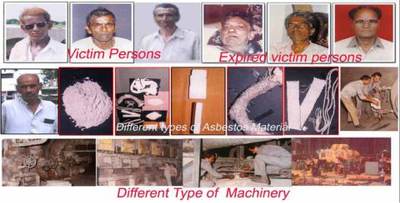
Pics and collage: Raghunath Manwar, occupational health activist.

It was in view of the deleterious effect of asbestos mining on the health of the workers, the central government ordered the state governments in 1986 not to grant any new mining lease for asbestos (including chrysotile variety) in the country. In June 1993, the central government stopped the renewal of existing mining leases of asbestos. The ban was imposed in phases in 1986 and 1993 but not on its use, manufacture, export and import, as noted earlier. But despite the ban on mining, illegal mines are operating in the states of Jharkhand, Rajasthan and Andhra Pradesh. Most asbestos-cement is using imported asbestos, some of it is being sourced from the illegal mining though that is a relatively small proportion.

To meet industry use requirements, white asbestos was imported during the years 2002-03, 2003-04 and 2004-05 respectively to the tune of nearly 100,000 metric tons per year. In addition to cement, it is also used in brakes, clutch linings, and gaskets in motor cars, as well as insulation and fireproofing in buildings and warships. It is also used in electrical distribution systems, and domestic products such as ironing boards.

Following a Supreme Court order on 14 October 2003 (Writ petition (civil) 657/1995), the Union Ministry of Labour constituted a Special Committee under Chairmanship of S K Saxena, Director General, Directorate of General Factory Advice Service and Labour on the issue of medical benefits and compensation to workers affected by handling of hazardous waste, toxic in nature. The Saxena Committee's report, submitted in May 2004, mentions lung cancer and mesothelioma caused by asbestos in all work involving exposure to the risk concerned.

Measures now afoot to lift the ban

The Union Ministry of Mines has proposed to lift the existing ban on mining of chrysotile asbestos. On 29 April 2005 the Minister of State for Coal and Mines, Dr Dasari Narayana Rao in a written reply in the Lok Sabha said that the study of Indian Bureau of Mines (IBM) "has recommended that the ban imposed on grant and renewal of mining leases and expansion of mining may be lifted." The study recommended that the mining ban may be lifted subject to control of pollution level in work environment of various operations and other remedial measures. But as an entity, the IBM is not independent of the Ministry; it functions under the Union Ministry of Mines and Minerals.

An in-depth study conducted by Industrial Toxicology Research Centre (ITRC), Lucknow in Beawer and Deovgarh Rajasthan observed higher fibre concentrations in the milling units. All the units are belonging to unorganised sectors where technology is poor and laws and regulations are simply not in force.


 •  Fibres of subterfuge
 •  Fibres of misinformation

On 10 March 2006, the Ministry of Mines and Minerals issued a statement saying, "IBM has been asked to work out necessary safeguards/measures in consultation with Central Pollution Control Board subject to which chrysotile asbestos mining can be permitted so as to ensure worker's safety."

The manifest support the industry appears to enjoy from the ruling United Progressive Alliance (UPA) seems illustrative of an unhealthy consensus, overall. In the meantime, research from leading Indian institutes continues to contradict the Ministry's push to lift the ban.

In an August 2005 paper published in American Journal of Industrial Medicine, titled "Occupational Asbestos Exposure and Predictable Asbestos-related Diseases in India," Dr S K Dave, Senior Deputy Director, NIOH concludes, "Based on knowledge of past and current exposures to asbestos in industry, we can predict a future occurrence of clinical asbestos-related diseases-pleural changes, pulmonary fibrosis, bronchogenic carcinoma, and diffuse malignant mesothelioma." He wrote that these cases of asbestos related disease are expected to occur in asbestos exposed workers from mining, milling, and manufacturing as well as in those with secondary exposures to asbestos-containing materials, including construction and maintenance workers, users of asbestos-containing consumer products, and the occupants of asbestos-containing buildings. Dr Dave's surveys of asbestos-exposed workers have revealed significant occupational exposures.

The NIOH was established by the Indian Council of Medical Research (ICMR), the apex body in India for the formulation, coordination and promotion of biomedical research, one of the oldest medical research bodies in the world presided over by the Union Health Minister.

Continue reading article...

Findings of the National Institute of Occupational Health, Ahmedabad.

Asbestos Cement industry: There are 18 asbestos cement factories located in different parts of the country. NIOH has carried out environmental epidemiological studies in four asbestos cement factories located in Ahmedabad, Hyderabad, Coimbatore and Mumbai. The prevalence of asbestosis in these factories varied from 3% to 5%. The levels of asbestos fibres were found to be higher than the permissible levels of 2 fibres/millilitre in two of the factories.

Asbestos Textile industry: Making of asbestos yarn and ropes is done mostly in the unorganised sector of industries with very poor safety measures. The average levels of air borne asbestos fibres varied from 216 to 418 fibres/ml. The permissible level is 2 fibres/ml. The prevalence of asbestosis was 9%. This relatively low prevalence of asbestosis despite high environmental levels was attributed to high labour turn over. Cases of asbestosis were observed in workers having less than 10 years exposure in contrast to the reported average duration of over 20 years.

Asbestos Mining and milling: In India, the mining and milling of asbestos is done in Cuddapah (Andhra Pradesh) and Devgarh (Rajasthan). Environmental and epidemiological studies in mining and milling units were carried out in both the places. In asbestos mines at both locations, the air borne fibre levels were within permissible limits. The average fibre levels in milling units varied from 45 fibres/ml to 244 fibres/ml of air. The overall prevalence of asbestosis in mining and milling units was 3% and 21% respectively.

An in-depth study conducted by Industrial Toxicology Research Centre (ITRC), Lucknow in Beawer and Deovgarh Rajasthan observed higher fibre concentrations in the milling units. All the units belong to the unorganised sector where technology is poor and laws and regulations are simply not in force. The ITRC team observed prevalence of asbestosis in less than five years, which is very high and alarming. ITRC is a constituent laboratory of Council of Scientific and Industrial Research (CSIR), an autonomous body associated with the Union Ministry of Education. It is dedicated to provide health safeguards to industrial and agricultural workers through its rich knowledgebase, created painstakingly over the years.

continue reading article ...


Have you made your contribution?
Dear Reader, if you have been a regular at India Together, then you already know that informative reporting on India Together is kept viable by a partnership between you and us. If you haven't yet made an annual contribution, now is the time to change that. Support us at one of the following levels:

    - Rs.1000 (recommended)
    - Rs.5000 (Friends of India Together)
    - Rs.500 (basic)

Contribute now | Why your support matters
p.s.: Your support is voluntary. Nevertheless, we rely on it.

Dr Qamar Rahman, a senior scientist with ITRC and a visiting Professor at Rostock University, Germany says that on the basis of the report and recent studies conducted in the milling units, the ban on asbestos mining should not be lifted. She notes that mining and processing are the part of each other and conditions need to be improved at both the places simultaneously. "In the milling or grinding area fibre concentration is very high, workers do not use gloves, masks and protective clothing. They use primitive manual way for grinding," she says, alarmingly. The housekeeping in the units are also very bad, feels Dr Rahman.

"At the moment unauthorised mining of asbestos is going on in Rajasthan and workers are heavily exposed. If the ban will be lifted conditions will further deteriorate. Keeping in view the above facts the ban on asbestos mining should not be lifted," said Dr Rahman in her comments to the central government on a report regarding lifting the ban on asbestos mining.

But the Ministry of Mines chooses to ignore such suggestions in the same way as it has ignored the plight of victims of white asbestos mines in Roro Hills, Chaibasa, Jharkhand abandoned by Hyderabad Asbestos Cement Products Limited (now known as Hyderabad Industries Limited). And the Ministry of Environment says it has not received any complaint so far.

The rationale to support the continued use of this killer fiber used in over 3,000 products is glaringly hollow. It continues to devastate workers and consumers, but the extent of the tragedy remains largely uncovered in India.

Gopal Krishna
12 Apr 2006

Gopal Krishna works as a consultant on clean industry and comments on environmental policy issues. He is also coordinator of Ban Asbestos Network of India (BANI).

 •  Write the author
 •  Post a comment on this article
 •  Health
 •  Health Hazards
 •  Mining
 •  Reprint permissions

Comments (5)

  • Posted by DR DALIP SINGH IAS,

    Do we have any study to know the health hazards in using the AC pipes in water supply system. I understand that a large number of state govt in India are using AC pipes despite their ban in many countries.Is there any law/regulation in this regard. DALIP SINGH, Commissioner and Secretary, water Supply and Sanitation Department, Govt Of Haryana, India

  • Posted by Gopal Krishna,

    Dear Dr Dalip Singh, There are studies to know the health hazards in using the Asbestos Cement pipes in water supply system.

    With regard to Asbestos Cement Pipes in water supply system, asbestos fibres are likely to become airborne with the passage of time due to erosion and wear and tear. Therefore, it is harmful to not only the workers who make these pipes but also to the consumers. In such a scenario, all studies concerning health hazards of asbestos are revant to the AC pipes in water supply system. Asbestos is a proven human carcinogen (IARC Group 1). No safe level can be proposed for asbestos because a threshold is not known to exist. The greater the exposure, the greater the risk of developing lung disease, therefore exposure should be kept as low as possible.

    For studies please visit the following websites: 1. WHO Air Quality Guidelines 2nd edition http://www.euro.who.int/document/aiq/6_2_asbestos.pdf 2. USEPA Office of Air quality Planning and Standards, Asbestos: Health and Exposure http://www.epa.gov/asbestos/health.pdf 3. Health and Safety Executive, 2003, Selection of Suitable Respiratory Protective Equipment for Work with Asbestos (INDG288(rev 1) http://www.hse.gov.uk/pubns/indg288.pdf 4. WHO Regional Office for Europe 2000, Asbestos and Health, 2nd edition. Local authorities, health and environment briefing pamphlet series, 25 5. International Chemical Safety Card 0014: Chrysotile http://www.inchem.org/documents/icsc/icsc/eics0014.htm 6. Environmental Health Criteria 53, 1986, Asbestos And Other Natural Mineral Fibres http://www.inchem.org/documents/ehc/ehc/ehc53.htm 7. Environmental Health Criteria 203, 1998, Chrysotile Asbestos http://www.inchem.org/documents/ehc/ehc/ehc203.htm

    The World Bank has a policy against asbestos since 1991. “The Bank increasingly prefers to avoid financing asbestos use...Thus, at any mention of asbestos in Bank-assisted projects, the Task Manager needs to exercise special care.”

    As per US Environmental Protection Agency, Asbestos may be released to water from a number of sources, including erosion of natural deposits, corrosion from asbestos-cement pipes, and disintegration of asbestos roofing materials with subsequent transport into sewers. The agency says, "Several occupational studies have reported an increase in gastrointestinal cancer from inhalation exposure to asbestos and subsequent oral ingestion." It is noteworthy some 40 countries have banned asbestos so far.
    In the most recent development on March 1, 2007 "Ban Asbestos in America Act of 2007" has been introduced in the Senate. The bill would
    authorize $10 million for each of the Fiscal Years 2008 through 2012. The bill has been referred to the Senate Committee on Environment and Public Works.

    But in India the government is pretending ignorance about these developments and getting its citizens exposed to Canadian asbestos.

  • Posted by Gopal Krishna,

    The first independent opinion poll to ascertain what people think about issues of environmental pollution in India was conducted by The Hansa Research Group between February 5 to 8, 2006 across 10 cities in India.

    The methodology: face to face interviews, using a structured questionnaire with a sample size of 983 people. The target audience for the research: opinion leaders like teachers, executives in Pvt. Sector, government officials, NGOs, college / university students, students of premier institutes – IIT / IIM, bureaucrats and judiciary, journalists, MDs / CEOs of manufacturing companies, general public – Male Female, SEC A/B, 18-60 years of age.

    The findings of the poll reveal among other things:
    80% of the respondents feel that the production of hazardous substances that are banned in the developed world, for example Asbestos, should also be banned in India.

  • Posted by N Mohan,

    I just can't understand this decision. On one hand we have Dr Kalam dreaming of India becoming a developed country soon. And on the other hand we have policy makers who are keen that we remain laggards. We don't become a developed country only by blasting missiles, testing nuclear bombs, and satellites into space; but by improving health standards and complying to environmental statutes.

  • Posted by Ganga Prasad Rao,

    I do not excuse exposure to asbestos at all, but as a geologist, I should point out that one of the problems encountered at mining sites is that talc, a mineral used extensively in the industry, is sometimes inter-layered with asbestos minerals. Thus, the mining of talc unwittingly disturbs asbestos layers and exposes workers to the risk of asbestosis.

    I would also like to point out that the 'permissible limit' of 2 fibers/ml is in itself a very lax standard. In the US, (based on the dated information with me), the US EPA set a short-term exposure limit, STEL, of 1 fiber per cc over a 30 minute sampling period, and an 8-hour time weighted average, TWA, of 0.1 fibers per cc. OSHA documents evidence pointing to health effects at exposure limits of 0.06 f/cc over an 8 hour averaging period. The carcinogenic risk from asbestos derives from its fibrosity down to micro dimensions. There are many other substances that are similarly fibrous (though not brittle) and subject to similar inhalation risk. If the health studies underlying regulatory action are true - and they undoubtedly are - then a much tighter PEL should be promulgated and made applicable to asbestos and other asbestos-like materials and substances.


Post a comment
Note: Your comment will appear within 24 hours unless found inappropriate (spam, netabuse).
See policy


Note: If you do not wish to post a public comment here and instead want to write a letter to the author directly, use the Write the author link that follows the author's byline at the end of the article.


Remember personal info?


For verification, please enter the security code you see below


View posted letters (5)
Note: Your post will appear within 24 hours unless found inappropriate (spam, netabuse). See policy

Comments powered by Movable Type 2.64 


In India
India Together
A-1205 Mantri Elegance
N S Palya,
Bannerghatta Rd
Bangalore
560076
Outside India
India Together
PO Box 26254
San Diego CA 92196
USA

Charge to your credit or debit card using the secure e-payment gateway of PayPal from anywhere.
Contribute now

HDFC Bank
Account Number 01332000003849
Account name: Civil Society Information Exchange
Account type: Current A/C
J P Nagar Branch, Bangalore
IFSC code: HDFC0000133


Ad Network :: Learn more 

Go to Interact - The AIDS battle: compromising values?


RECENTLY IN INDIA TOGETHER
 •  Democracy as vaccine
 •  One third of the lawmakers
 •  Securing live-in relationships
 •  Teen journalists make their own newspaper
 •  Water sector reforms: Time for a new model
 •  Kerala revises controversial school textbook
 •  Higher education: The underbelly of privatisation
 •  Winning the battle against poaching
 •  In Kurukshetra, a new victory
 •  "Just let a woman be"
 •  Lessons up the hill in Mcleodganj
 •  For the people, by the government?
 •  Softening hard water with rain
 •  Military cooperation with the US: A mixed bag
 •  Consent under duress
 •  Children in the crossfire at Nandigram
 •  Mumbai's eye in the sky
 •  An argumentative Indian look at China
 •  The Hindu Jinnah?
 •  Despair and defensiveness in Azamgarh
 •  Praja Rajyam: Caste-ing a political net
 •  Nagpur cargo hub plan drives villagers desparate
 •  Milkmen of a dying village


© Civil Society Information Exchange Pvt. Ltd., all rights reserved.
Home | About us | Overview | Support | Contact Us | Disclaimer