








If your journey along the west coast still remains picturesquely green, thank the chants that had rented the air of this region 25 years ago, and which seemingly echo even today. Chanting the Kannada slogan of Ulisu, Belasu and Balasu, meaning save, grow and sustain, the forest-loving people of Uttara Kannada - the most green district in the country stood up against the tyranny of the state that was clearing the native forests to pave way for monoculture plantations.
The 25-year-long journey
History was created on 8 September 1983 when people from villages around Salkani in Uttara Kanada district undertook an eight-kilometre-long trek to resist massive tree-felling operations underway at the Kalase forests. Hordes of men and women lay seize to the forest over the next three months, hugging the trees and forcing the perpetrators with little option but an unceremonious exit.
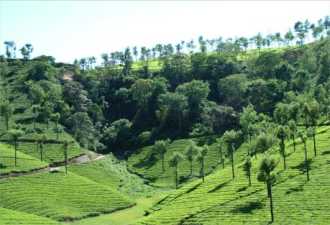
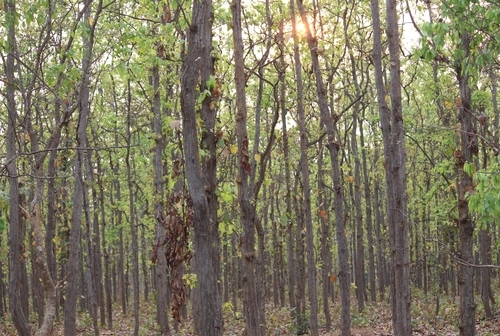
 Western ghats, a biodiversity hotspot. Pic: From Paradise Lost, a report published by Prakruti, Uttara Kannada, Karnataka.
The news spread fast, catching the imagination of forest dwellers across the state in Kodagu, South Kanara, Chikamaglur and Shimoga districts. Appiko, meaning hug the trees, soon became a potent expression to counter violence against nature, reflecting empathy towards forests. It seems a cosmic force was fuelling indelible energy into each of us, recalls M N Mableshwar of Gubbigadde village in Sirsi.
The villagers of Gubbigadde and Balegadde, who were the first to lodge a formal protest against clear felling, wonder if Appiko could have found a better home than Uttara Kannada. Called the forest district, this region had an impressive 82 per cent of its geographical area under forests in 1950, earning the tropical evergreen forests in the Western Ghats the distinction of being one of the 16 global biodiversity hotspots in the world.
Despite hailing from the forest district himself, then Chief Minister of Karnataka Ramkrishna Hegde took six years to withdraw the timber concessions given to forest based industries and impose a moratorium on felling of green trees in the natural forests. Passed in 1990, the order has been valid till date. But for this order, the region would have long been shaved off its pristine green cover for filling the insatiable desire for industrial development mining, paper industry, hydro power and railways.
Dubious justifications for forest clearance have made a mockery of the order, laments Pandurang Hegde, who not only led the movement but continues to anchor it. Six hydropower projects including a nuclear power plant on the 184-km short stretch of river Kali have already accounted for loss of 21,000 hectares of forests. The irony is that of the 1800 MW power being produced in the district, local consumption doesn't exceed 18 MW.
New challenges
There are significant milestones that the movement recounts as it begins to prepare itself for the challenges that lie ahead. Given the fact that the global discourse on democracy toes the neo-liberal model of market economy, the future of social movements like Appiko face new challenges. As consumerism casts its influence on young minds, the next generation lacks the empathy to align with social causes.

•
Some good news on conservation
•
A familiar battle at Tadadi
Building a fresh engagement with the younger generation to sustain countervailing forces and contest the oppressive policies of globalisation is a formidable challenge, admits Hegde. The key word of ecology has been replaced by economy and conservation makes room for consumption. In the present context, environment versus development debate is considered anti-growth both by the state as well as sections of the public. Be it land, water or forests, each natural entity gets viewed through an economic standpoint. Obsession with growth has helped brew widespread apathy towards ecological conservation. Needless to say, times have changed and the challenges have been further compounded since Appiko movement was launched 25 years ago.
Success for Appiko
Appiko may have lost some ground to changing developmental priorities but the ethos of a movement guided by sheer grit and determination still persists. Three years ago, it organised a massive protest against the proposed 4,000 MW Barge Mounted Power Plant at Tadadi. Over 25,000 people protested the setting-up of a plant that could have devastated 1,800 hectares of estuary, created at the point where river Aghanashini empties itself into the Arabian Sea. The livelihoods of local fishermen came in handy in making a case against the proposed project.
The scrapping of the proposed seventh dam on river Kali and the holding back of the proposed rail link cutting across 2,000 hectares of tropical forests between Hubli and Ankola on account of environmental clearance are more examples of the success and continued relevance of Appiko.
Appiko has neither been opposed to growth nor development; it views nature conservation complementary to human growth and survival. While forests can be converted into monetary terms, there is no way the fundamental role of tropical forests in pulling the strong oceanic currents to offload their showers can have a replacement. As the threat of climate change becomes real, there could not be anything more pressing than protecting the monsoon gateway (i.e., Sahyadri) to the country.
With a view to convert present challenges into future opportunity and to showcase the significance of the Western Ghats from a wider perspective, it has been decided that the historic day of 8 September will henceforth be observed each year as the Sahyadri Day, so that the chants of Ulisu, Belasu and Balasu continue to echo in the region. From modulating climate change to maintaining river discharge and from maintaining biodiversity to enriching nutrient regime, preservation of tropical forests can open a new window of opportunity at the global scale to generate unique ecological capital. It is in this context that Appiko is repositioning itself for a major role in the coming years.